

 |
 |
 |
 |
 |
 |
The Blood & Circulation The Lymphatic System The Immune System
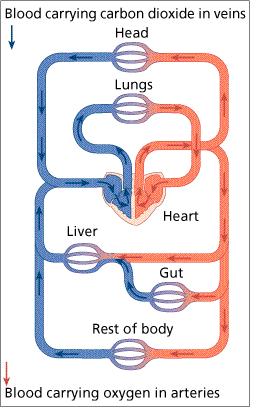
The blood circulates throughout the body. It carries nutrients (food) to all the cells of the body. And carries away waste products so that they can be removed from the body. Without access to the blood, cells and body tissues die.
The circulationThe blood moves around the body inside the circulatory system. This is made up of blood vessels (tubes) called arteries, veins and capillaries. The blood keeps moving through these blood vessels because it is pumped through by the heart.
Arteries carry blood that is full of oxygen from the heart to all parts of the body. As the arteries get further and further away from the heart, they get smaller and smaller.
Eventually they turn into capillaries. These are the smallest blood vessels. They go right into the tissues. Here the blood in the capillaries gives oxygen to the cells and picks up the waste gas, carbon dioxide, from the cells.
The capillaries are connected to the smallest veins in the body. The veins get bigger and bigger as they carry the blood back towards the heart.
The blood passes through the right side of the heart and goes to the lungs where it gets rid of carbon dioxide and picks up more oxygen.
It then passes through the left side of the heart and is pumped back around the body. 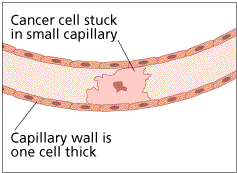
The blood always circulates through the body in the same direction. As well as oxygen and carbon dioxide, many other substances are carried in the blood. The blood circulating through the digestive system picks up digested food products and carries them to the liver to be used or stored.
The circulation can help explain why some cancers nearly always spread to the same place. Cancers of the colon (large bowel) often spread to the liver. This is because blood circulates from the bowel through the liver on its way back from the heart. If there is a cancer in the large bowel, and some cancer cells have found there way into the circulation, they may stick in the liver as the blood passes through. They can then begin to grow into secondary cancers.
 The blood
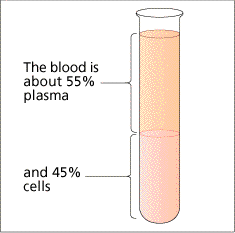
 Although blood looks like a red liquid, if some is left in a test tube it separates out into a pale liquid called plasma and a solid layer of blood cells.
The blood is about 55% plasma and 45% cells. Plasma is mostly water with some proteins and other chemicals dissolved in it.
There are three main types of cells in the blood
White blood cells
There are several different types of white blood cells in the blood in differing amounts. They all play a part in the immune response. This is the response of the body to infection or anything else the body recognises as 'foreign'. These blood cells can be made very quickly and generally have a short life. Some only live for a few hours, others for days.
The total white cell count is normally between 5,000 and 10,000 per cubic millimeter. If you have surgery or an infection, your white blood cell counts will go up within a day or two.
The most numerous of the white blood cells are the neutrophils. There are between 3,000 and 6,000 of these per cubic millimeter of blood. They are important for fighting infection. If you have chemotherapy, particularly high dose, your doctors will probably talk about your neutrophil count.
The next most numerous are the lymphocytes. A normal lymphocyte count is between 1,500 and 3,000 per cubic millimeter of blood. Lymphocytes are involved in making antibodies as part of the immune response.
Red blood cells Red blood cells give the blood its red colour. There are more than 4 or 5 million of them in every cubic millimeter of blood. A red blood cell can live for up to 120 days.
Red blood cells are able to attach to oxygen to carry it within the circulation to the tissues. When they get to an area where the oxygen is needed, they give it up and pick up carbon dioxide which they carry back to the lungs. A shortage of red blood cells is called anaemia. The role of the red blood cell in carrying oxygen explains why very anaemic people usually feel breathless.
Platelets Platelets are really bits of much bigger cells called megakaryocytes. A normal platelet count is between 140,000 and 340,000 per millimeter of blood.
Platelets are very important in blood clotting. They clump together to form a plug to stop bleeding and then secrete other chemicals that help the blood to clot and the blood vessel to be repaired.
 How are blood cells made?
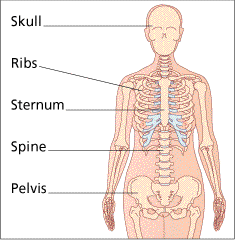
 All the different types of blood cells develop from one type of cell called a 'blood stem cell'. In adults, blood stem cells are normally found in the red bone marrow inside the bones. Blood cells are made in the bone marrow in the skull, ribs, sternum (breast bone), spine and pelvis.
The stem cells divide and multiply to make the blood cells. These cells differentiate (develop and mature) as they grow into white cells, red cells or platelets.
It is now possible to collect stem cells and freeze them. They can then be given back after high dose chemotherapy treatment.
Chemotherapy and the blood cells If you are having chemotherapy, you will know that it affects your blood counts. Chemotherapy often kills cells that are actively multiplying.
The developing blood cells are multiplying all the time as they mature. So they are also killed by the chemotherapy drugs. The white cell counts are affected first because many white cells in the circulation naturally die off within a few days at most. Normally these are replaced by newly developed white cells. But the developing white cells have been killed by chemotherapy. So there will be a short wait before more can be made. About a week or two in fact. Just in time for your next course of chemotherapy!
The mature red blood cells live for about three months. So it is a lot further into your chemotherapy course (if at all) that you may become anaemic or short of red blood cells. Your doctor may want you to have a transfusion of red cells rather than wait to make up the shortfall as this can take quite a while with red blood cells.
Chemotherapy can also make you become very short of platelets. If you do, you may get nose bleeds, or notice a red rash on your skin like tiny bruises. Your doctor may then want you to have a platelet transfusion. After high dose chemotherapy it can take longer for the platelet count to get back to normal than any other blood cell count.